BE CAREFUL NOT TO CONFUSE A ‘HAY BELLY’ WITH FAT!
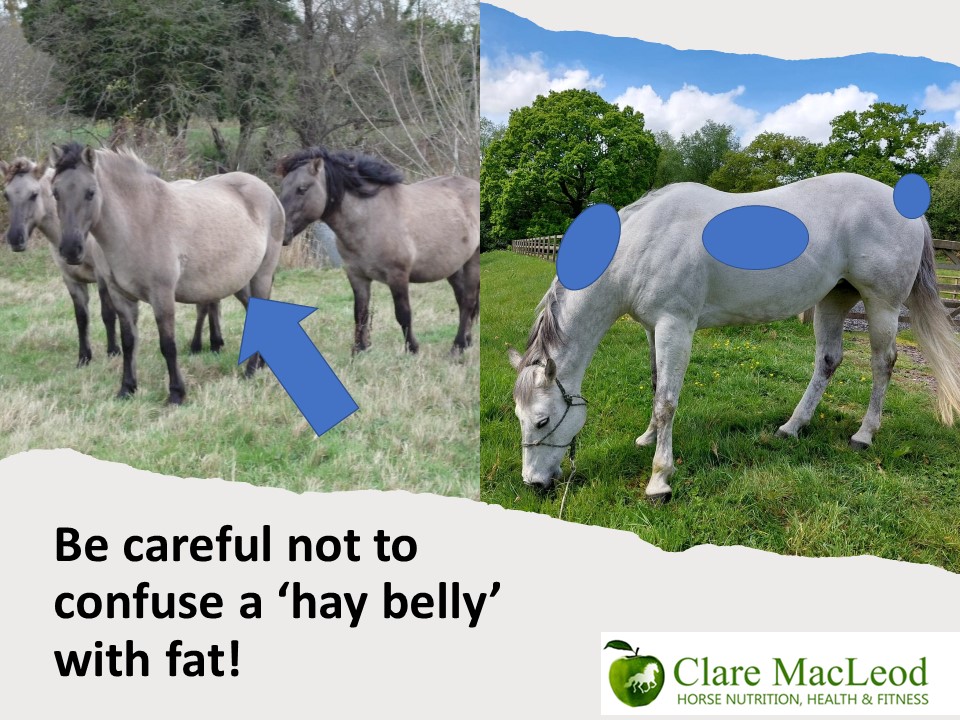
I regularly see horses with quite large bellies, but who are not particularly fat. I also sometimes see horses with ‘streamlined’ bellies, who carry a moderate or high level of body fat.
A wee while ago, I saw two horses on a yard whilst out doing Consultation visits and the one with the larger (relative) belly had the lower external body fat level.
A ‘hay belly’ – a distended abdomen – tends to occur in horses who are not worked in such a way to tone their abdominal muscles, and who have a large intake of fibrous forage. Forage holds water in the horses’ gut and the higher in fibre it is, the more it holds. The horse’s hindgut has a volume of around 150 litres (half a large bathful).
Fat does not get laid down in significant amounts on the horse’s belly, until they are extremely obese.
There are exceptions to the above, but the key is to feel for fat, and not just look at the horse’s belly.
Feel for fat in the neck crest, behind the shoulders and over the ribs, over the pelvis and at the top of the tail.
Consider using a condition scoring guide to be sure you are assessing actual body fat covering if you’re not sure. You can find one in a blog on my website (link in the comments).
It might be that a horse with a big belly of grass (or hay) is overweight as well, but it is possible for a horse to be too thin in terms of body fat covering, but have a big ‘hay belly’.
Feel free to share!
Also feel free to share your ‘hay bellies’ below!
🐴🍏